
Every summer, guests on our fishing charters and hiking trips ask some version of the same question: is there gold on Kodiak Island? It’s a fair question given Alaska’s mining history, and the honest answer is more interesting than a simple yes or no. We’ve spent years guiding guests through the same coastal drainages and river mouths that rockhounds and gold panners ask about, so here’s what we actually know from the ground.
The Short Answer About Gold on Kodiak Island
Kodiak Island does have a documented history of small-scale gold discoveries, mostly tied to placer deposits in a handful of drainages on the island’s west and southwest side, not far from where our lodge sits in Larsen Bay. These deposits were never large enough to trigger a rush like the ones on the mainland or in the Interior. Most of what’s been found over the decades amounts to fine flour gold and small flakes, not nugget-sized finds.
Why Kodiak Never Became a Major Gold Region
Kodiak’s geology is dominated by the Kodiak Formation, a thick belt of slate and graywacke that formed from ancient marine sediment rather than the volcanic and intrusive rock that typically hosts richer gold veins. There are some mineralized zones and old prospect pits scattered around the island, remnants of early 20th-century exploration, but nothing on the scale of the goldfields further north. If you’re coming here specifically hoping to pan a fortune, we want to set that expectation honestly.
Where Small Gold Deposits Have Been Found
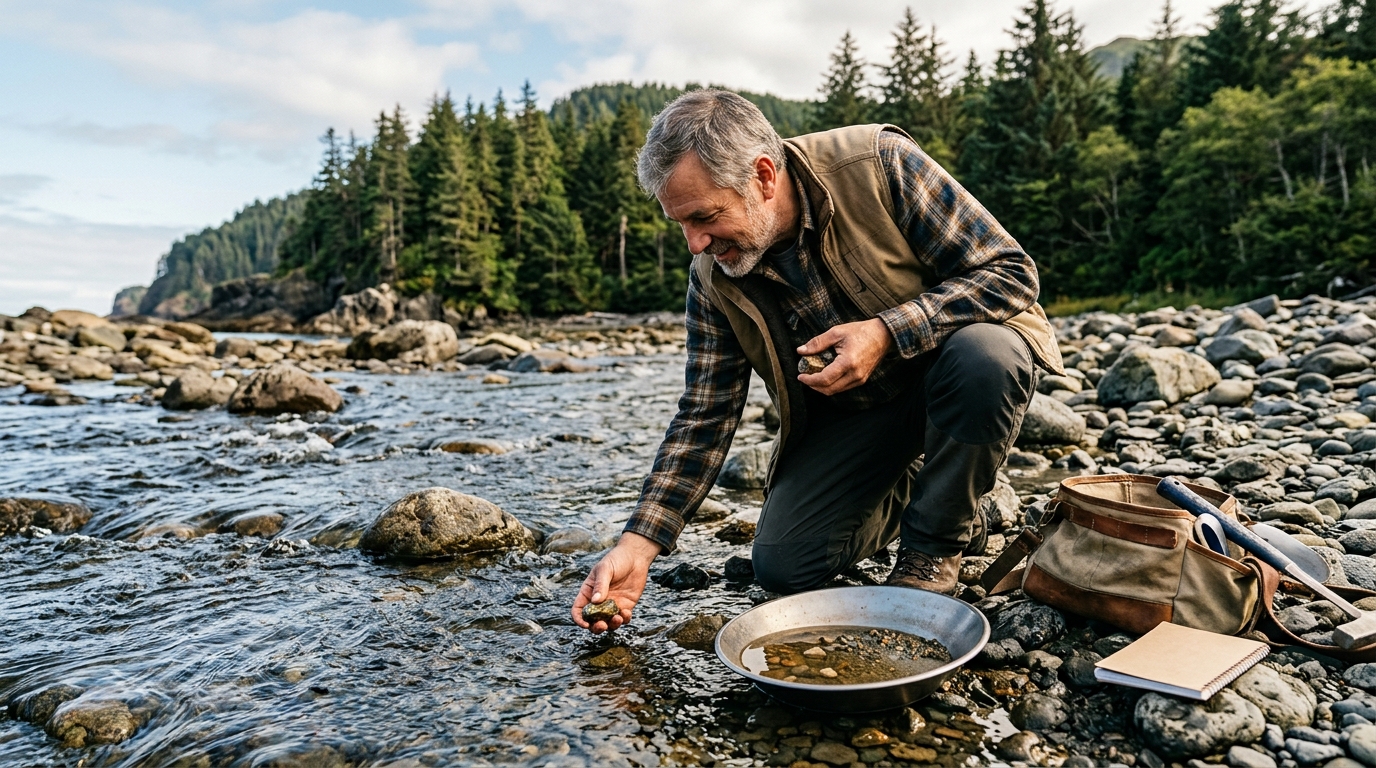
The historical record points to a few specific areas, including drainages near Larsen Bay and Uyak Bay, where prospectors filed claims in the early 1900s. Some of these same creek systems are within reach of the hiking routes we guide today, which is part of why the question comes up so often from our guests. If you’re curious about the terrain itself, our guide to the forest terrain along our hiking routes gives a good sense of what these drainages actually look like on foot, dense Sitka spruce stands giving way to open creek beds.
What Prospectors Actually Recovered
Records from early claims describe recovery in the range of fine gold dust, occasionally with small flakes mixed in gravel bars. There’s no evidence of a productive mine ever operating long-term on Kodiak Island itself. The gold that’s here is real, but it’s scattered, fine, and labor-intensive to recover in any meaningful quantity.
What You’re More Likely to Find Instead
If gold is the reason you’re asking, we’d steer your expectations toward what Kodiak actually delivers in abundance: interesting rock and mineral finds along the beaches and riverbanks. Our guests who beachcomb during a break from fishing regularly turn up agates, jasper, and sea glass polished smooth by the tide. We cover a lot of this in our article on beachcombing for agates, jasper, and sea glass, which is a much more realistic hobby to plan around than gold panning.
Common Rocks and Minerals on Kodiak
Beyond the beach finds, hikers on our guided routes sometimes spot quartz veins, basalt, and other sedimentary rock exposed along eroded slopes and stream cuts. If you want a fuller rundown of what turns up on Kodiak hikes, we put together a guide covering what minerals turn up on Kodiak hikes based on what our guides have pointed out to guests over the years.
Should You Bring a Gold Pan on Your Trip?
Honestly, we don’t recommend building a Kodiak trip around gold panning. Access to the old prospect drainages is limited, much of the land requires permission to cross, and the payoff for the effort is small even by hobby standards. Guests who come to Kodiak Island for the wilderness experience tend to get far more out of the fishing, wildlife viewing, and hiking than they would panning a creek for flour gold.
A Better Use of Your Time in the Backcountry
The same terrain that hosted those old gold claims is also some of the best wildlife habitat on the island. Brown bears, Sitka black-tailed deer, and bald eagles are far more reliably encountered than gold, and our guided hikes are built around exactly that experience. Our own guide to Kodiak Island trails that pass through prime wildlife habitat covers the routes where we’ve had the most consistent sightings, and they overlap with some of the same creek drainages people ask us about for gold.
Fishing and Adventure Still Define Kodiak’s Real Value
Where Kodiak genuinely delivers is in its waters, not its creek beds. The nutrient-rich bays and channels around Larsen Bay support strong runs of halibut, salmon, lingcod, rockfish, and Pacific cod, and that abundance is the real reason anglers travel this far southwest of Anchorage. It’s also why we built our resort around guided charters rather than mineral exploration.
Pairing Fishing with Wilderness Exploration
Most of our guests split their time between a guided fishing charter and one of our land or water-based adventures, whether that’s a hike through wildlife habitat, a kayak excursion along the coastline, or a bear viewing trip timed to salmon season. None of these require any prior knowledge of geology or prospecting, just an interest in seeing Kodiak Island up close.
Plan Your Kodiak Island Adventure With Us
If you’re drawn to Kodiak Island’s wild terrain, whether for the fishing, the wildlife, or simply the scenery, we can put together a trip that fits what you’re actually after. Our guided halibut, salmon, lingcod, rockfish, and Pacific cod charters pair naturally with hiking, kayaking, and bear and wildlife viewing excursions out of Larsen Bay. Get in touch with us to talk through what a personalized itinerary could look like for your visit.