Guests who fly into Larsen Bay for a week of halibut fishing often ask us the same question once they see the mountains and the tide flats: where does the name Kodiak actually come from? The answer to how Kodiak Island got its name involves two very different peoples, a fur trade empire, and a word that has outlasted both. Knowing that history gives a bit more weight to the water you’re fishing and the trails you’re walking.
The short version is that the name traveled through Alutiiq, then Russian, before landing in the English we use today. But the short version skips the parts that matter most, so let’s slow down.
How Did Kodiak Island Get Its Name From the Alutiiq People?
Long before Russian ships arrived, the island was home to the Alutiiq people, whose villages were scattered across the bays and river mouths of the archipelago, including the area now known as Larsen Bay. Their word for the island, often rendered as “Qikertaq,” simply meant “island” in their language. That word wasn’t unique to this one island; it was a general term Alutiiq communities used for land surrounded by water, which is a detail that gets lost in most tourist summaries.
The name we now recognize, Kodiak, is not a direct translation of Qikertaq. It’s closer to a Russian mishearing and adaptation of a related Alutiiq word, likely tied to a village name the Russians encountered on the island’s eastern side. Over time, that adapted word stuck to the whole island rather than just the original village or settlement it described.
If you want the fuller picture of who was living here and where their descendants remain today, our earlier piece on the Alutiiq tribes who first called the island home walks through each community and how they connect to modern Larsen Bay.
The Russian Chapter That Reshaped the Name
Russian fur traders arrived in the late 1700s, drawn by sea otter pelts and the promise of a foothold in the North Pacific. Kodiak Island became central to that ambition almost immediately. Grigory Shelikhov established a settlement at Three Saints Bay in 1784, and for a period the island served as the administrative center of Russian America before the capital moved to Sitka.
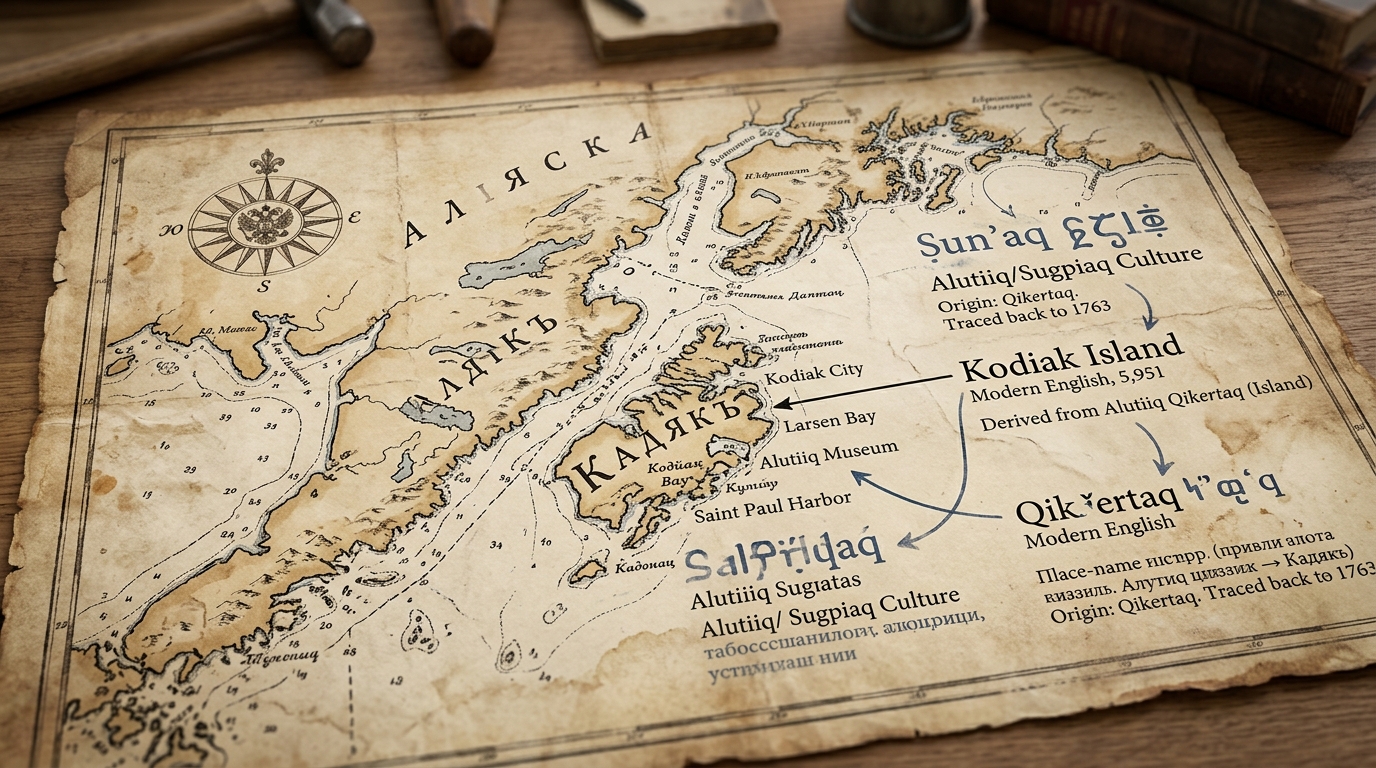
During this era, Russian record keepers were transcribing Alutiiq place names as best they could, often without much consistency. “Kodiak” is the spelling that survived from those records, even though it’s an imperfect stand-in for the original Alutiiq sounds. The Russians also renamed villages, moved populations to consolidate labor for the fur trade, and left a mark on the island’s place names that still shows up on maps today.
We’ve written in more depth about this period in our article on Kodiak Island as Russia’s first capital in Alaska, which covers how the settlement grew and why it eventually lost that status.
Why the Spelling Stuck
Once American administrators took over Alaska in 1867, they largely kept the Russian-era place names rather than trying to restore original Alutiiq terms. That’s a pattern you see across the state, and it’s part of why so many Alaskan place names sound Russian even in areas with deep Indigenous history. Kodiak was simply the name that made it onto official charts, and it never changed back.
What Kodiak Means Today
For most visitors, Kodiak now refers to three overlapping things: the island itself, the archipelago of smaller islands around it, and the city of Kodiak on the eastern shore. Larsen Bay, where our lodge sits, is part of that same island but on the opposite coast, tucked into a quieter stretch of water known for its salmon runs and halibut grounds.
The name has also become shorthand for a specific kind of Alaska experience: remote, wild, and defined by the water as much as the land. That reputation isn’t just marketing. The island’s position in the Gulf of Alaska puts it in some of the most nutrient-rich waters on the Pacific coast, which is exactly why the fishing here holds up trip after trip.
A Living Alutiiq Identity, Not Just a Name
It’s worth remembering that Kodiak is a name imposed from outside, but the Alutiiq culture behind the island’s original identity never disappeared. Alutiiq language, art, and traditions are still practiced across Kodiak’s villages today. If you want to see that firsthand during your stay, a visit to the Alutiiq Museum on Kodiak Island is a practical way to fit that history into a fishing trip without losing a day on the water.
Other Chapters Worth Knowing Before You Visit
The naming history is just one thread in a longer story. Kodiak Island has also been shaped by natural events that rearranged daily life for everyone living here, Alutiiq and Russian settlers alike. Our article on the 1912 volcanic eruption that buried Kodiak Island in ash is a good next read if you want to understand how dramatically the landscape has changed even in the last century or so.
Between the Alutiiq roots, the Russian colonization, and the natural disasters that followed, Kodiak Island’s name carries more history than most visitors expect when they book a week of fishing. That context tends to make the mountains, the bays, and even the fish feel a little more grounded in something real.
Bring That History Into Your Trip
Once you know the story behind the name, it’s worth experiencing the island it belongs to. We run guided halibut, salmon, lingcod, rockfish, and Pacific cod charters out of Larsen Bay, and we pair those trips with bear viewing, wildlife viewing, and whale watching excursions for guests who want the fuller Kodiak experience between days on the water. Reach out to us at Kodiak Island Resort and we’ll help you build a trip that fits your goals, whether that’s a serious halibut charter or a slower mix of fishing and wildlife viewing.