If you spend a few days at Larsen Bay chasing halibut and silver salmon, you will also spend time looking past the boat rail at the shoreline. The dense, dark green tree line that wraps around the bay is not what most people picture when they think of Alaska. Understanding the kodiak island forest that borders our waters gives you a better sense of what you are seeing on every charter, hike, and kayak paddle we run out of the lodge.
The short version is that Kodiak Island sits at the edge of a temperate rainforest system, and the forest here behaves more like a coastal Pacific Northwest woodland than the spruce-and-tundra image most visitors expect from Alaska.
The Kodiak Island Forest Is a Sitka Spruce Rainforest, Not Tundra
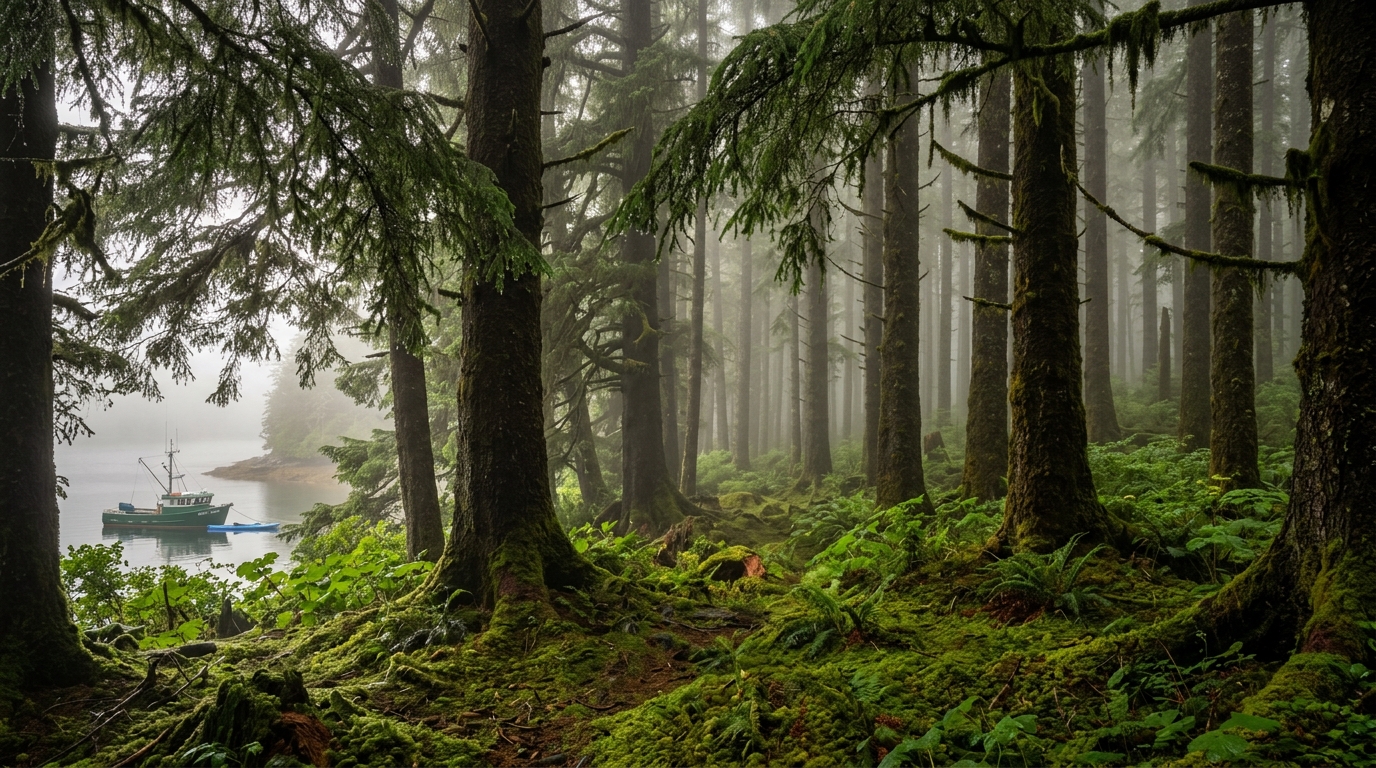
Kodiak’s forests are dominated almost entirely by Sitka spruce, with the occasional western hemlock mixed in near the northeastern part of the island. These trees thrive here because Kodiak sits in a wet, mild, maritime climate zone fed by the Gulf of Alaska. Heavy rainfall, cool summers, and mild winters create conditions closer to a rainforest than a boreal forest.
This is different from mainland Alaska, where black spruce and white spruce dominate drier, colder interior forests. Kodiak’s version grows thicker, wetter, and greener, with a canopy that closes in fast once you leave the open muskeg or beach grass areas near the water.
Why the Trees Stop Where They Do
One of the more interesting things about Kodiak’s forest is how abruptly it ends. Large sections of the island, especially toward the south and west near Larsen Bay, are treeless tundra and grassland rather than forest. Scientists generally attribute this to a combination of wind exposure, soil conditions, and the relatively recent natural spread of spruce across the island following past glacial and volcanic activity. The result is a patchwork landscape where dense spruce forest gives way to open alpine tundra within a short hike, sometimes in the same afternoon.
What Grows Beneath the Canopy
Step into the forest itself and the ground cover is often more dramatic than the trees above it. The understory on Kodiak is thick, wet, and fast growing during the short summer season.
- Devil’s club, a large-leafed plant with sharp spines, common along stream banks and shaded slopes
- Salmonberry and blueberry bushes, which fruit through the summer months
- Thick moss and lichen coating fallen logs and rock faces
- Ferns and skunk cabbage filling in low, wet drainage areas
- Tall grasses and devil’s club forming dense barriers off-trail
Not everything growing in this understory is safe to touch or eat, and a few common berries and plants on the island are best left alone. Our guide to poisonous plants and berries to avoid on Kodiak Island is worth a read before you go picking anything trailside.
The Forest Floor Changes with the Season
Kodiak’s growing season is short but intense. Wildflowers, fireweed, and understory greenery move through fast phases from late spring into early fall, and the timing shifts what you will actually see on a given trip. If you want your hike or kayak trip to line up with peak color and bloom, our seasonal breakdown of the best time to see Kodiak Island’s wildflowers and greenery in bloom covers what to expect month by month.
How the Forest Shapes Wildlife on the Island
The forest and the coastline are not separate systems here, they work together. Salmon runs pushing into streams near Larsen Bay draw brown bears out of the timber and into open, visible ground, which is part of why bear viewing trips from the lodge are timed around specific runs. Deer move through the spruce stands for cover, bald eagles perch in the tallest trees along the shoreline, and the tree line itself acts as a windbreak that keeps calmer water along certain stretches of coast, useful to know if you are watching for whales from shore or planning a paddle.
What This Means for Hikers and Kayakers
If you are hiking a forested trail near Larsen Bay, expect wet footing, low visibility once you are under the canopy, and a real chance of encountering wildlife at closer range than open tundra allows. Kayaking along the treed shoreline puts you closer to nesting seabirds and feeding wildlife than most inland trails do. For a rundown of what you might spot from the water, including near the tree-lined stretches of coast, our guide to seabirds you’ll spot from the water near Larsen Bay is a good companion to a paddling day.
Fitting a Forest Walk Around Your Fishing Day
Most of our guests are here first for the fishing, and the forest is something they experience in the hours around a charter rather than as the main event. That works well on Kodiak, since several good trails near Larsen Bay are short enough to fit before or after a half-day halibut or salmon trip. If you want specifics on timing and trail options, our article on pairing hikes with your fishing charter lays out which trails work best around a typical charter schedule.
Plan Your Time in Kodiak’s Forest with Us
Between halibut, salmon, lingcod, rockfish, and Pacific cod charters, we also run hiking adventures, kayaking excursions, bear viewing trips, and wildlife viewing outings that put you right up against the kind of coastal spruce forest described here. If you are planning a stay at Kodiak Island Resort and want to build in time on the trail or on the water alongside your fishing days, reach out to us and we will help you put together a schedule that works for your group.