
When you step off the boat in Larsen Bay and look up at the mountains ringing the harbor, you’re looking at a landscape with a human story stretching back roughly 7,500 years. Understanding kodiak island history gives context to the waters you’ll fish and the trails you’ll walk during your stay, and it explains why this place still feels so wild and unspoiled. Here’s a timeline of the people, events, and disasters that shaped the island into what it is today.
Kodiak Island History Begins With the Alutiiq People
Long before any European set foot on this coastline, the Alutiiq people had built a thriving culture around the island’s rich waters. They settled in villages near protected bays, including the area around what is now Larsen Bay, relying on salmon runs, sea mammals, and marine resources for food, tools, and trade.
Their knowledge of the tides, fish migrations, and weather patterns was passed down over generations and still informs how locals and guides read these waters today. If you want a deeper look at their society, our earlier piece on the Koniag people and their traditional way of life covers how they lived before outside contact changed everything.
A Name Rooted in Native Language
The island’s name itself has native origins, though its exact meaning has been debated for years. We dug into this question in detail in our article on how Kodiak Island got its name, which traces the linguistic roots back to the Alutiiq language.
Russian Contact and Colonization
Russian fur traders arrived in the late 1700s, drawn by the island’s abundant sea otter population. Contact was often violent, and it permanently altered Alutiiq society through disease, forced labor, and the imposition of a new economic system built around the fur trade.
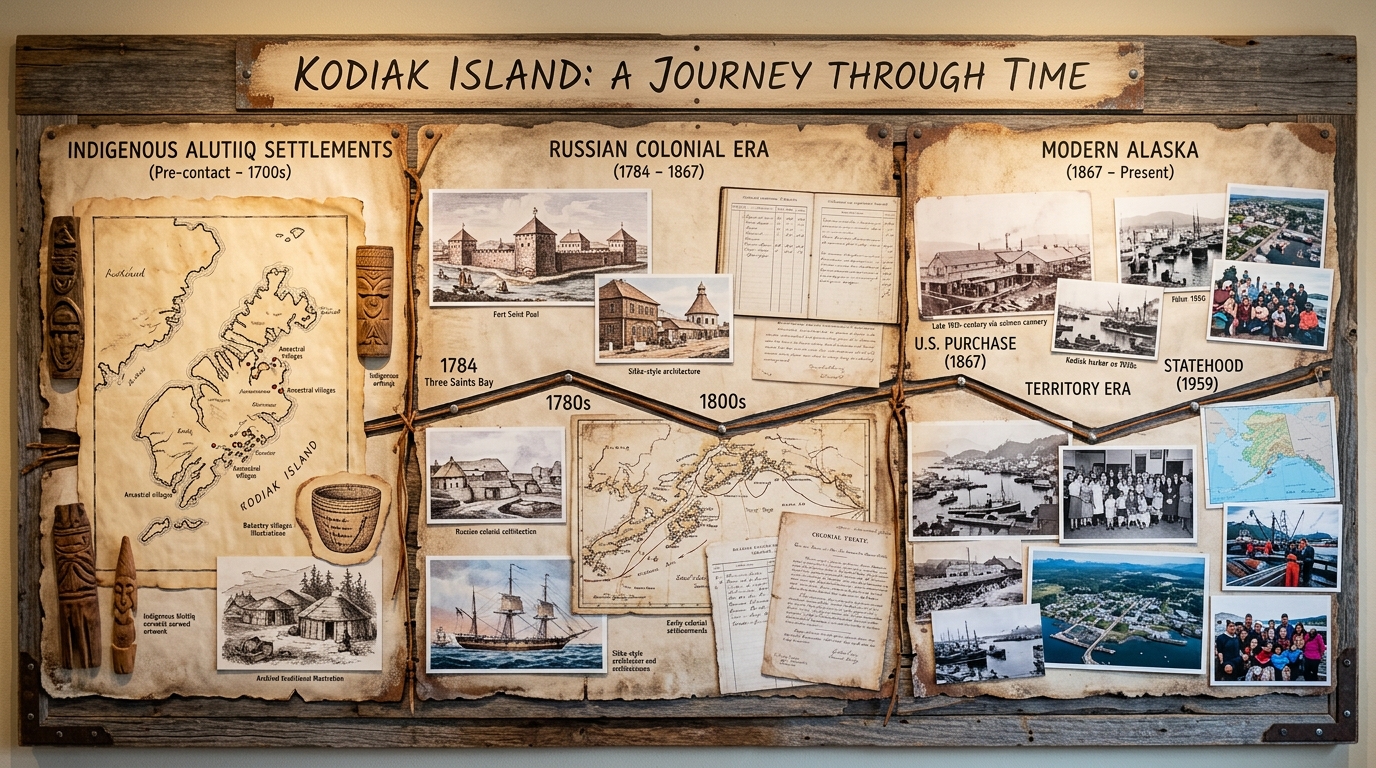
By 1784, Russian merchant Grigory Shelikhov had established a permanent settlement at Three Saints Bay, making Kodiak Island the first capital of Russian America. That chapter of the island’s history, including why the capital eventually moved to Sitka, is laid out in our article on Kodiak Island as Russia’s first capital in Alaska.
Kodiak Under American Rule
The United States purchased Alaska from Russia in 1867, and Kodiak Island slowly transitioned from a Russian fur outpost into an American territory. Fishing and canning became the dominant industries through the late 1800s and early 1900s, with salmon canneries popping up along the coastline, including near Larsen Bay.
This era set the foundation for the commercial fishing economy that still defines much of the island today, and it’s part of why the waters around Kodiak remain so well suited to sustainable, productive fishing.
World War II on Kodiak Island
Kodiak’s strategic position in the North Pacific made it a key military site during World War II. The U.S. Navy built a major base on the island, and at its peak, thousands of military personnel were stationed there to defend against potential Japanese attacks following the invasion of nearby Aleutian islands.
Remnants of bunkers, gun emplacements, and old roads from this period are still scattered across the island, and some hiking routes near Kodiak pass directly by these historic military remains.
Natural Disasters That Shaped the Island
Kodiak Island history isn’t only about people. Two major natural events reshaped the physical land itself and left a lasting mark on local communities.
The 1912 Novarupta Eruption
In June 1912, the eruption of the Novarupta volcano on the Alaska Peninsula buried Kodiak Island under a thick layer of volcanic ash. Villages went dark for days, breathing became difficult, and the ash permanently altered soil conditions and terrain across parts of the island. We cover this event in more depth in our article on the 1912 volcanic eruption that reshaped the island, including how it affected daily life in villages near Larsen Bay.
The 1964 Good Friday Earthquake
On March 27, 1964, the second largest earthquake ever recorded struck south central Alaska, triggering a tsunami that devastated low lying areas of Kodiak Island. Entire sections of the town of Kodiak were destroyed, and the disaster forced a long rebuilding effort that reshaped the waterfront and local infrastructure for decades afterward.
Kodiak Island History Today, in Larsen Bay
Modern Larsen Bay sits quietly at the intersection of all these layers of history, Alutiiq heritage, Russian influence, wartime infrastructure, and recovery from natural disaster. The village itself remains small and close to the land, with a strong connection to subsistence fishing that echoes practices thousands of years old.
When you’re out on a charter chasing halibut or salmon, you’re fishing the same nutrient rich waters that sustained the Alutiiq people long before anyone else arrived on this coast.
Experience Kodiak Island’s History on the Water
Learning the history behind Kodiak Island adds another layer of appreciation to a trip built around fishing and wilderness. Our halibut, salmon, lingcod, rockfish, and Pacific cod charters put you on the same waters that have supported life here for thousands of years, and our bear viewing, wildlife viewing, and hiking trips give you a close look at the land itself. If you’re planning a trip to Larsen Bay and want a lodge that treats both the fishing and the history seriously, get in touch with us and we’ll help you build an itinerary around what interests you most.