
When you touch down on Kodiak Island, you’re landing on ground that has been fished, settled, and fought over for thousands of years. Understanding the history of Kodiak Island Alaska gives you a richer sense of the water you’ll be casting into and the community that has grown up around it. Here’s the short version, from the island’s first inhabitants to the fishing frontier it is today.
Alutiiq Origins: The First People of Kodiak Island
Long before any European ship reached these waters, the Alutiiq people (also called Sugpiaq) had built a life on Kodiak Island around salmon runs, sea mammal hunting, and the rhythms of the North Pacific. Archaeological evidence suggests their ancestors arrived here more than 7,000 years ago, making Kodiak one of the longest continuously inhabited places in Alaska.
The Alutiiq developed skin boats called baidarkas, sophisticated enough to hunt whales and sea otters far offshore, and villages spread across the island’s bays and inlets, including the area now known as Larsen Bay. Salmon was central to their diet and culture then, just as it remains central to the region’s identity today.
Russian Fur Trade and the Founding of Kodiak
Russian fur traders reached Kodiak Island in the 1780s, drawn by sea otter pelts that fetched enormous prices in Chinese markets. In 1784, Grigorii Shelikhov established a settlement at Three Saints Bay, the first permanent Russian colony in Alaska. The settlement later moved to what is now the city of Kodiak under the direction of Alexander Baranov, who ran the Russian-American Company’s operations from the island for years.
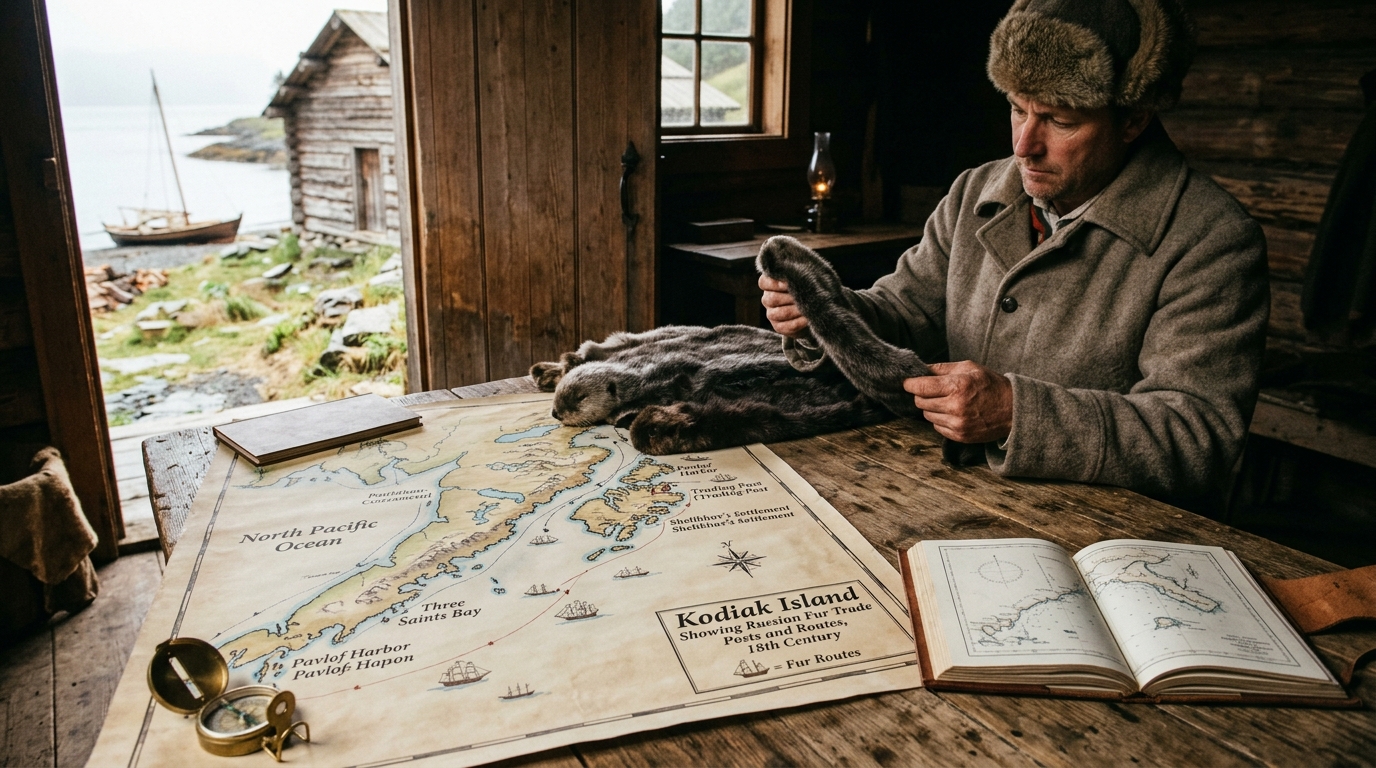
This period was brutal for the Alutiiq population. Russian traders forced many Alutiiq men into hunting parties and imposed harsh labor demands, and disease introduced by outsiders reduced the native population significantly. It’s a hard chapter, but an honest accounting of Kodiak’s history has to include it alongside the more romantic stories of exploration and trade.
Russian America Company Era
For roughly 80 years, Kodiak served as a hub for Russian fur trading activity in Alaska before the company’s headquarters eventually shifted to Sitka. Russian Orthodox missionaries also arrived during this era, and their influence is still visible today in the churches and place names scattered across the island.
The American Purchase and a Shift Toward Fishing
In 1867, the United States purchased Alaska from Russia, and Kodiak Island came under American control along with the rest of the territory. The fur trade that had driven Russian interest in the region was already in decline, and attention gradually turned to a resource that would define Kodiak for the next century: fish.
Salmon canneries began appearing along Kodiak’s coastline in the late 1800s and early 1900s, built to process the massive runs of sockeye, pink, and chum salmon returning to the island’s rivers and streams each summer. These canneries brought new settlers, new jobs, and a fishing economy that has never really let up since.
Larsen Bay: From Cannery Town to Fishing Frontier
Larsen Bay itself grew up around this cannery industry. A salmon cannery was established here in the early 20th century, and for decades the bay operated as a working fishing community tied to the seasonal salmon harvest. That cannery heritage is part of why the waters around Larsen Bay are so productive today, sitting at the mouth of a bay that has funneled fish for over a hundred years.
The 1964 Good Friday earthquake, one of the most powerful ever recorded in North America, reshaped much of coastal Alaska, including parts of Kodiak Island’s waterfront and fishing infrastructure. The island rebuilt, and its fishing industry not only recovered but expanded into the diverse commercial and sport fishery that exists today.
From Commercial Fishing to Sport Fishing Destination
As commercial fishing matured on Kodiak, word spread about the quality of the sport fishing available in the same waters. Anglers began traveling to the island specifically for halibut, salmon, lingcod, and Pacific cod, drawn by the same nutrient-rich waters that had supported Alutiiq villages and Russian fur traders centuries earlier.
Kodiak Island Today: Wilderness, Wildlife, and World-Class Fishing
Modern Kodiak Island balances its working fishing ports with a thriving sport fishing and adventure travel industry. Brown bears, bald eagles, whales, and sea otters share the landscape with commercial fleets and lodges, and Larsen Bay has become known as a base for guests who want serious fishing without giving up comfort at the end of the day.
That combination of history and abundance is exactly what brought us to Larsen Bay in the first place. If you want to see what a day on these waters looks like, our halibut fishing charter gives you a direct look at the same nutrient-rich grounds that have supported fishing communities on this island for generations, guided by people who know the bay’s moods and the fish that move through it.
Bringing the History With You to Larsen Bay
Knowing where you’re headed makes the trip mean more once you’re standing on the dock. We’d encourage you to spend some time on our home page to see how we’ve built our lodge around this same landscape, from guided charters to bear viewing and wildlife excursions, all rooted in the same waters that have drawn people to Kodiak Island for thousands of years. When you’re ready to plan a trip, we’re happy to help you put together a stay that fits your fishing goals and your sense of adventure.