
If you’re searching for the best rivers to fish on Kodiak Island, you’re probably picturing yourself wading a clear stream with salmon stacked up nose to tail. The real story is a little different, and honestly more interesting. Kodiak’s rivers feed directly into the bays and coastal waters where our guided charters actually fish, which means the river systems shape almost everything you’ll catch out on the boat.
Understanding how these rivers connect to the surrounding saltwater helps explain why Larsen Bay produces such consistent fishing for salmon, halibut, lingcod, rockfish, and Pacific cod. Here’s how it all fits together and what you can expect to find where Kodiak’s rivers meet the sea.
Why Kodiak’s Rivers Matter Even If You’re Fishing By Boat
Every summer, salmon leave the ocean and push into Kodiak’s river systems to spawn. That migration doesn’t just matter for river anglers. It draws bait, nutrients, and predator fish into the bays and inlets near river mouths, which is exactly where our charters operate. The result is a saltwater fishery that’s directly tied to what’s happening upstream.
This is part of why Larsen Bay sits in such a productive location. The nutrient-rich waters here support everything from schooling salmon to bottom-dwelling halibut and lingcod, and it’s a big reason our guests consistently find good numbers of fish close to home water.
Larsen Bay and the Karluk River System
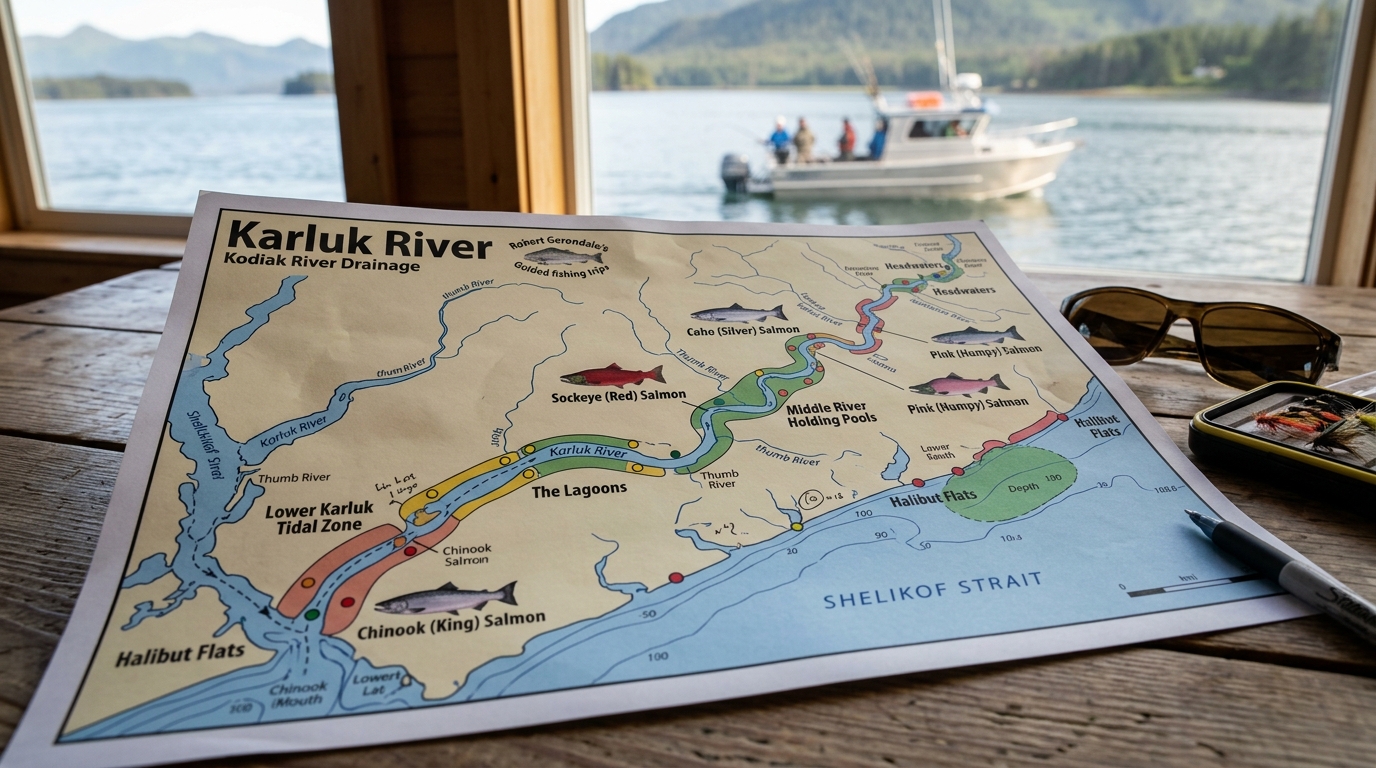
Larsen Bay is positioned near the Karluk drainage, one of the most storied salmon systems in Alaska. Karluk Lake and the river that flows from it have supported salmon runs for generations, and that legacy still shapes the fishing in the surrounding bay today. When salmon stage near the river mouth before heading upstream, they’re vulnerable to both anglers and the halibut and lingcod that follow the bait.
You can get a full sense of our location and how it connects to these waters on our home page, where we lay out exactly why Larsen Bay makes such a strong base for a fishing trip.
The American River and Local Salmon Runs
The American River flows directly into Larsen Bay itself, giving local salmon a short, direct path from the ocean to their spawning grounds. Because the river empties so close to where our charters run, the salmon moving through this system often show up in good numbers in the bay before they ever reach fresh water.
This proximity is one of the practical advantages of fishing out of Larsen Bay. You’re not running hours to find fish that are staging near a river mouth. In many cases, that productive water is right outside the harbor.
Species You’ll Find Where Kodiak’s Rivers Meet the Sea
The mixing zone where fresh water and salt water meet is one of the most productive areas on the water. Baitfish gather here, salmon pass through on their way upstream, and bottom fish set up nearby to take advantage of the activity. Here’s what that typically means for anglers fishing with us.
Salmon
Kodiak’s rivers support multiple salmon species throughout the season, and their runs stagger from mid-May through mid-September. As fish stage near river mouths before pushing upstream, they’re often feeding aggressively, which makes for some of the most exciting fishing of the trip.
Halibut
Halibut aren’t a river fish, but they hold in the deeper water just outside river mouths and bay entrances where current and structure concentrate food. Our halibut fishing charter trips target these areas specifically, since the same nutrient flow that supports salmon runs also feeds the halibut population nearby.
Lingcod
Lingcod favor rocky structure and drop-offs near the coastline, often not far from where rivers empty into the bay. They’re aggressive, hard-fighting fish that tend to hold tight to structure rather than roam open water.
Rockfish
Rockfish are another structure-oriented species found along the rocky ledges and reefs near river mouths and coastal points. They’re a reliable catch throughout the season and often mixed in with lingcod on the same grounds.
Pacific Cod
Pacific cod tend to hold near the bottom in similar areas to rockfish and lingcod, particularly where current and depth create good ambush points. They round out a day of bottom fishing nicely alongside the other species.
What a Guided Kodiak Fishing Trip Actually Looks Like
A typical day starts by looking at conditions and tides, then deciding whether the priority is salmon near a river mouth, halibut in deeper water, or a mixed bag of lingcod, rockfish, and cod along the structure. Trips are built around what our guests actually want to catch, not a fixed itinerary, so the plan can shift based on what’s running that week.
Because Larsen Bay sits so close to these productive river systems, we’re rarely running long distances to find fish. That means more time with lines in the water and less time in transit, which matters when you’ve traveled a long way for the trip.
Timing Your Trip to the Right Fishery
Our season runs mid-May through mid-September, and different species peak at different points along the way. Salmon runs build and taper as the summer progresses, while halibut, lingcod, rockfish, and Pacific cod remain solid options for most of the season since they aren’t tied to a single spawning migration.
If you have a specific species in mind, it’s worth planning your trip around that run rather than just picking dates at random. We can help match your visit to the fishery that’s producing best at that time.
Plan Your Kodiak Fishing Trip
Kodiak Island’s rivers do a lot of the work before a single line ever hits the water, feeding the bays and coastal structure that make Larsen Bay such a productive place to fish. If you’re ready to see it firsthand, we’d be glad to help you put together a trip built around the species and experience you’re after.