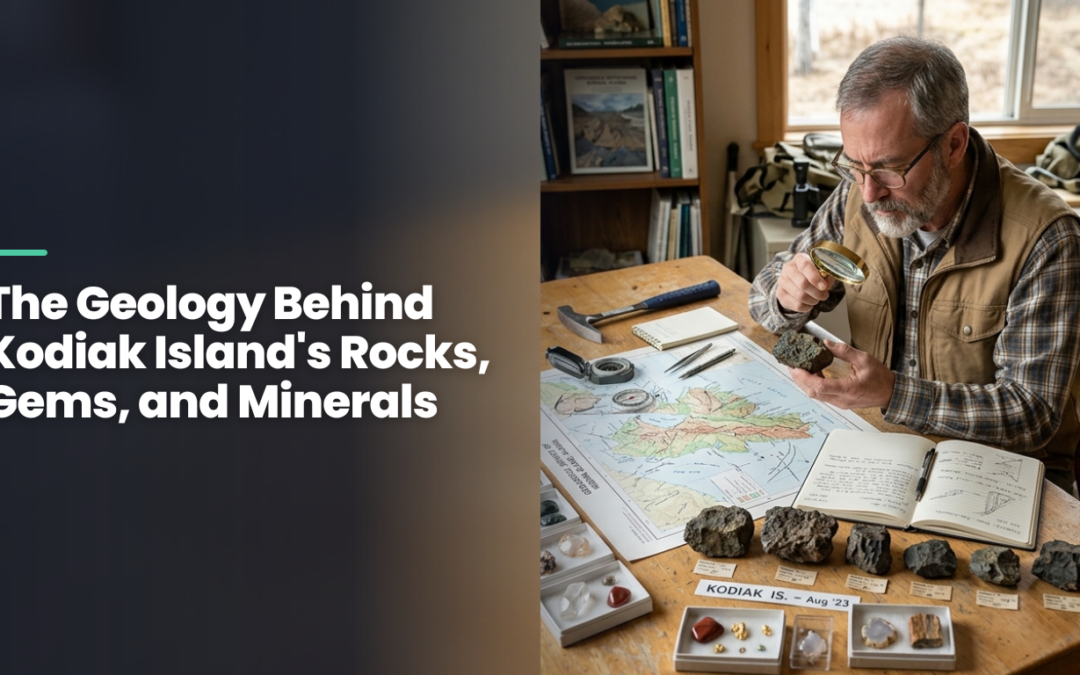
Guests who spend a morning on the water chasing halibut often spend the afternoon walking a beach or trail near Larsen Bay, and the question we hear most isn’t about fish. It’s about the rock. Kodiak Island geology is a story of volcanoes, grinding ice, and a restless seafloor, and once you know a little of it, every cliff and cobble beach around the lodge starts to make sense.
The Volcanic Origins of Kodiak Island Geology
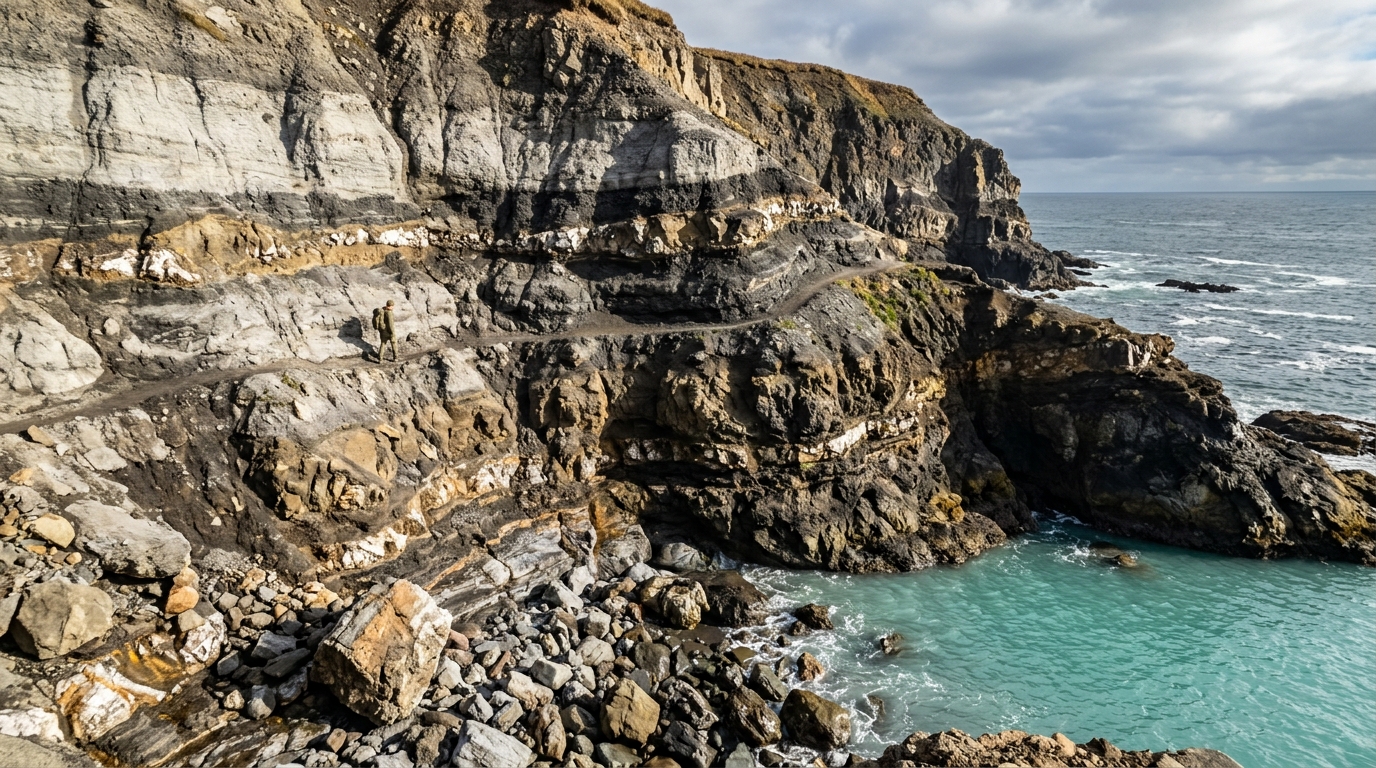
Kodiak Island sits on the edge of the Pacific Plate, where it has been sliding under the North American Plate for tens of millions of years. That slow collision built much of the bedrock you see today, including the dark, dense greywacke and slate that make up the ridgelines above Larsen Bay. These rocks started as ocean sediment, got folded and compressed under heat and pressure, and eventually rose up to form the spine of the island.
Unlike the volcanoes on the Alaska Peninsula just across Shelikof Strait, Kodiak itself isn’t an active volcanic island. What you’re looking at here is older, deeper material, scraped and uplifted from an ancient sea floor rather than built from recent lava flows.
Glaciers That Carved the Coastline
If the bedrock is the island’s bones, glaciers are what gave it its shape. During the last ice age, thick ice sheets moved across Kodiak and carved out the steep fjords, U-shaped valleys, and deep bays that define the coastline, Larsen Bay included. As the ice retreated, it left behind the rounded hills, scattered boulders, and gravel deposits that hikers notice along inland trails.
Signs of Glacial Activity You Can Still See
- Smooth, rounded rock faces scraped by moving ice
- Steep-walled bays with deep water close to shore
- Loose boulder fields far from any cliff they could have fallen from
- Valleys shaped like a broad U rather than a narrow V
Larsen Bay itself is a good example. Its depth and shape are the direct result of glacial carving, which is part of why the water here stays so productive for salmon and halibut even close to shore.
What You See on the Trails and Shoreline Today
Walk any beach near the lodge and you’ll find a mix of rock types that tell this whole history in miniature. Dark volcanic and metamorphic stones from the old seafloor sit alongside lighter granite and quartz that glaciers carried in from elsewhere on the island. Waves and tides have been sorting and polishing this material for thousands of years, which is why Kodiak’s beaches are such good hunting ground for interesting stones.
We’ve written before about the specific stones people turn up here, including agates and beach stones you can find on Kodiak Island and a separate guide to where Kodiak’s garnets tend to show up. Both are worth a read if you want to know what you’re looking at once you’re standing on the beach.
A Coastline Still Being Reshaped
Kodiak’s geology isn’t finished. The same plate boundary that built the island’s bedrock is still active today, and it has produced some dramatic, sudden changes. When guests stand on the dock at Larsen Bay and look out at the calm, deep water, few realize they are looking at a coastline that was violently rearranged in a matter of minutes. We go into detail on this in our post on how the 1964 earthquake reshaped Kodiak’s coastline, which is worth reading if you want to understand how recent and sudden some of this landscape’s changes have been.
Where to Look If You Want to See It Yourself
Understanding the geology is one thing. Finding good rock on your own is another. If you want a practical starting point, our guide covering where to find agates and jasper around Larsen Bay lays out specific spots and tips for fitting a beach walk around your fishing schedule. It’s the same ground our guests cover between charters, so it’s written with that rhythm in mind.
The best approach is to treat it as a complement to fishing, not a separate trip. A low tide after a morning on the water is often the best time to walk the shoreline, since more beach is exposed and the light is usually better for spotting color in the stones.
Plan Your Time Between Charters
Most of our guests come for the salmon, halibut, lingcod, rockfish, and Pacific cod charters, but the hours between trips are a good chance to see the landscape that makes this fishing so good in the first place. If you’re planning a stay with us, ask about pairing a fishing day with some time for hiking or a walk along the shoreline, and we can help you find a stretch of beach or trail that fits your schedule. Get in touch with us to start planning your trip to Larsen Bay.